
You Do Not Need a Hospital to Build an Exceptional Surgical Practice
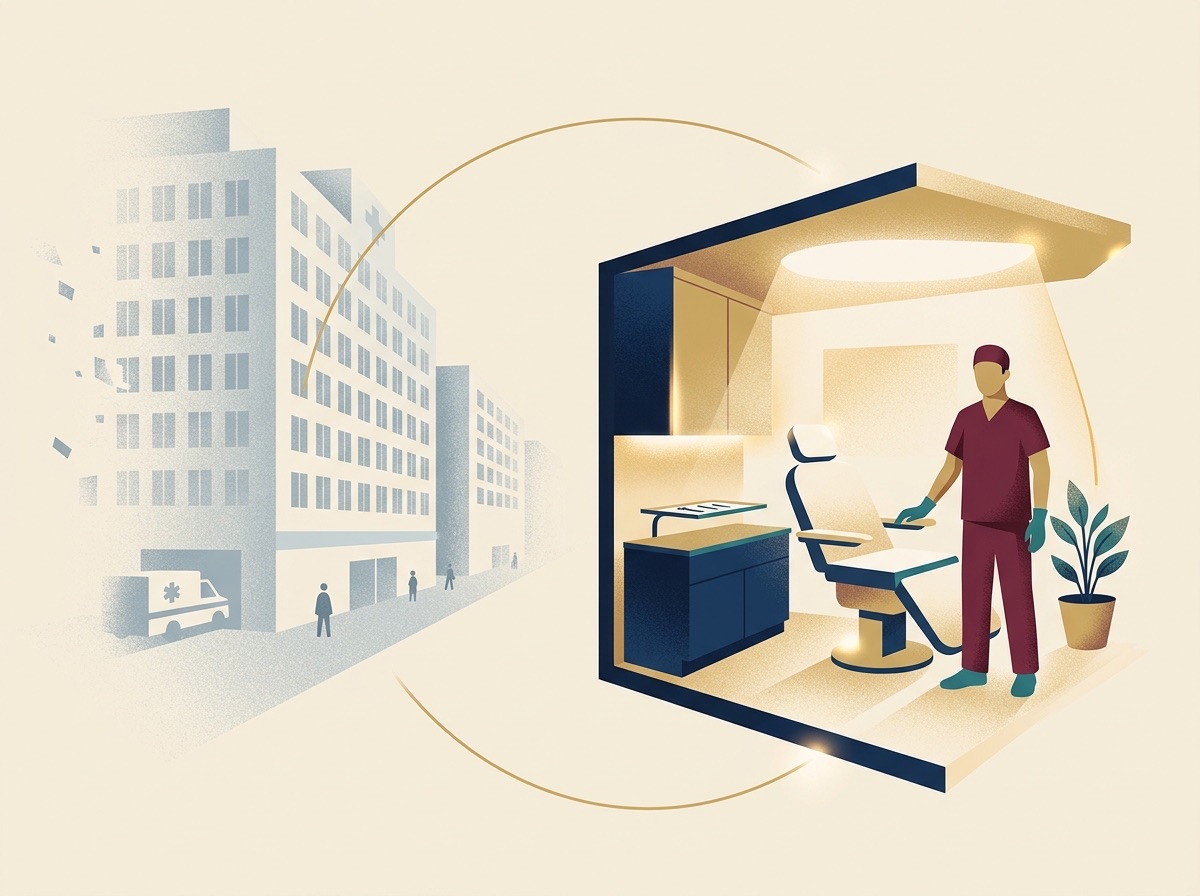
This one is for the doctors who have been told - directly or indirectly - that real surgical volume requires hospital privileges, an ASC affiliation, or a hardware system from one of the major implant companies.
I want to respectfully challenge that assumption.
The model I have built at Feet ’N Beyond - and the model I teach through WWN Consulting Group - is built entirely around what I call hardware-free, office-based surgery. No pins. No screws. No plates. No implants. No hospital.
Just technique, precision, and a well-trained team operating in a beautifully designed office surgical suite.
I am not saying hospitals are unnecessary. For the right case, the right patient, and the right complexity level, hospital access matters. What I am saying is that a significant portion of the foot and ankle surgical volume that currently goes to hospitals and ASCs does not need to be there - and keeping it there is costing you time, money, and control.
The Cases Most Doctors Think Require a Facility Often Do Not
Bunion corrections. Hammertoe repairs. Bone spur excisions. Aesthetic corrections. Forefoot reconstruction. Many of these can be performed safely, effectively, and beautifully in an office setting - when the surgeon is properly trained and the systems are properly built.
What it requires is not more equipment. It requires better training, smarter patient selection, a well-prepared team, and the confidence to do it differently than the way you were taught.
That confidence is buildable. That system is learnable. And the practice that emerges on the other side of that investment is something most doctors in this profession have never experienced - because they never believed it was available to them.
It is available. And we can show you exactly how to build it.
The hardware-free, office-based surgical model is not a shortcut. It is the result of deliberate training, smart systems, and a team that believes in what you are building.
Dr. Helene Nguyen, DPM is the founder of WWN Consulting Group. To explore coaching programs or apply for the MIS Mastery Program, visit our Programs page.
Dr. Helene Nguyen, DPM is a podiatric surgeon, MIS specialist, and founder of WWN Consulting Group and Feet ’N Beyond of New Jersey. She coaches foot and ankle physicians on surgical mastery, office-based surgery systems, aesthetic procedures, and complete practice transformation.
Frequently Asked Questions
What does hardware-free foot surgery mean?
Hardware-free surgery describes techniques performed without implanted pins, screws, plates, or similar fixation devices. It does not mean that implants are never useful or that every deformity should be treated the same way. The surgeon must choose an approach based on the pathology, patient, desired correction, training, evidence, and resources available for safe follow-up.
Can a surgeon build meaningful surgical volume without hospital privileges?
An office-based model may allow an appropriately trained physician to perform selected procedures without relying on a hospital for every case. However, hospital or ASC access can remain important for higher complexity, anesthesia needs, medical risk, or unexpected escalation. A resilient practice model defines both its office capabilities and its referral or transfer relationships.
Which cases may fit an office-based, hardware-free approach?
The article discusses categories such as selected bunion corrections, hammertoe repairs, bone spur excisions, aesthetic corrections, and forefoot procedures. That list is not a universal indication guide. Suitability must be determined individually through examination, imaging, informed consent, risk assessment, applicable standards, and the surgeon’s competence with the proposed technique.
What systems are needed to build this model responsibly?
The practice needs formal training, clear selection and exclusion criteria, a prepared surgical space, sterile workflows, staffing protocols, documentation, supplies, emergency readiness, postoperative access, and continuous outcome review. Business planning matters too, but it should follow the clinical model. WWN coaching connects those clinical, team, patient-experience, and operational pieces.
Does an independent surgical model eliminate the need for hospital relationships?
No. Independence means greater control over selected care, not isolation from the broader healthcare system. Surgeons still need dependable referral, imaging, medical-clearance, emergency, transfer, and higher-acuity pathways. Maintaining appropriate hospital or ASC relationships can strengthen an office-based model because the practice can place each patient in the setting that best matches the procedure, medical risk, and resources required.